

Snoring often stems from an incorrect tongue position in the mouth. Learn why, and which simple exercises may help establish a healthy tongue resting position.
What to expect:
Sound familiar? Your partner complains about your snoring at night, you wake up in the morning feeling completely worn out - and so far no one has explained to you why. One possible factor often lies right behind your teeth: in the position of your tongue.
What actually happens when you snore?
Snoring occurs when the air you breathe meets resistance on its way through the nose, mouth, and throat. The soft tissues in the throat - the soft palate, the uvula, and the throat walls - begin to vibrate. This produces the typical snoring sound.
But why does this airway narrow in the first place?
This is where the tongue comes in. Many people don't realize that the tongue should have a fixed „resting place“: at rest it often lies against the palate over a large area, with the tip of the tongue gently touching the area just behind the upper front teeth.
The tongue as a muscle group: a quick look at the anatomy
The tongue is not simply an organ - it is a highly complex group of muscles made up of eight different muscles. These can be divided into two groups:
- Intrinsic tongue muscles: Change the shape of the tongue (making it wider, narrower, thicker)
- Extrinsic tongue muscles: Move the tongue within the mouth (forward, back, up, down)
The extrinsic muscles are especially important for our topic, because they connect the tongue to:
- the lower jaw (genioglossus muscle)
- the hyoid bone (several muscles)
- the styloid process of the temporal bone (styloglossus muscle)
What does this mean in practice? The tongue literally hangs from a finely tuned system of muscular cables. When this system doesn't work properly, the tongue falls backward at night - and narrows the airway.
Why tongue position matters so much
1. The tongue as a natural shaper of the palate
In children, the correct tongue position serves a crucial function: it shapes the upper jaw. The constant gentle pressure of the tongue from the inside against the palate acts like a natural orthodontic appliance.
Studies on craniofacial development show that children who breathe through the mouth long-term (and whose tongue therefore sits low) more frequently develop:
- a narrow, high palate
- too little room for all the teeth
- a recessed chin
- narrowed airways
2. The tongue as an airway opener
When the tongue rests against the palate, two important things happen:
First: The base of the tongue (the back part) is automatically pulled forward and up. This keeps the throat wide and open.
Second: The muscle tension (the so-called muscle tone) throughout the pharyngeal muscles improves. The soft tissues in the throat become more stable and don't collapse as easily at night.
3. The tongue and nasal breathing
Here an important circle closes: the correct tongue position supports nasal breathing - and nasal breathing in turn stabilizes the tongue position.
Why is nasal breathing so important?
The nose is not just an air filter. It serves several functions:
- Warming the air you breathe to body temperature
- Humidifying (prevents the mucous membranes from drying out)
- Filtering out particles and pathogens
- Producing nitric oxide (NO) - a gas that widens the bronchi and improves oxygen uptake
People who breathe through the mouth miss out on these benefits. At the same time, mouth breathing causes the tongue to sit low in the mouth - a vicious cycle.
How can you recognize an incorrect tongue position?
Many people have never learned where their tongue is actually supposed to be. Here are typical signs of an unfavorable tongue position:
Directly observable:
- •The tongue lies flat on the floor of the mouth
- •The tip of the tongue presses against the lower teeth
- •The mouth is often slightly open
- •You often breathe through your mouth (especially while sleeping)
Indirect signs:
- •Tooth imprints along the sides of the tongue (the tongue is constantly pressing against the teeth)
- •Dry mouth in the morning
- •Frequent throat clearing (due to dried-out mucous membranes)
- •Difficulty swallowing or a „lump“ feeling in the throat
- •Snoring or even pauses in breathing (sleep apnea)
The connection between tongue position and snoring: the mechanics behind it
Imagine your throat as a tube. This tube has no rigid walls made of bone - it is stabilized by muscles and soft tissue.
What happens with the correct tongue position?
When the tongue rests against the palate:
- The genioglossus muscle (the largest tongue muscle) is active and pulls the base of the tongue forward.
- By way of the hyoid bone (a small, freely suspended bone in the throat) the pharyngeal muscles are also tensioned.
- The entire throat stays wide and stable.
- The air can flow more freely - in some people this can reduce snoring.
What happens when the tongue sits low?
- •When the tongue lies on the floor of the mouth:
- •The base of the tongue falls backward during sleep
- •It narrows the throat like a valve
- •The air has to flow through a narrower passage
- •The flow speed increases (like a garden hose that you squeeze)
- •The soft tissues begin to vibrate - and the snoring sound is created
In pronounced cases, the base of the tongue can even block the airway completely. This leads to pauses in breathing (obstructive sleep apnea) - a serious condition with an increased risk of high blood pressure, heart attack, and stroke. If sleep apnea or daytime sleepiness is suspected, a medical evaluation (e.g., sleep medicine/ENT) is necessary.
Why does the tongue end up in the wrong position at all?
The causes of an unfavorable tongue position are varied:
In children:
- Chronically congested nose (due to allergies, enlarged adenoids)Pacifier or thumb sucking beyond the age of threeFood that is too soft (the chewing muscles aren't trained sufficiently)A tongue tie that is too short (limited mobility)
In adults:
- Habitual mouth breathing since childhoodChronic sinus infectionsExcess weight (additional fatty tissue in the throat)Muscular imbalances in the head and neck regionStress and tension (leading to altered breathing and swallowing patterns)
The connection to posture
A fascinating aspect: tongue position influences not only the throat, but your entire posture.
The biomechanical chain
The human body is an interconnected system of muscles, fascia, and bones. By way of the hyoid bone, the following are connected:
- The tongue (upward)
- The chewing muscles and the lower jaw
- The neck muscles (backward)
- The laryngeal muscles (downward)
- Through fascia, even the back muscles all the way down to the pelvis
Practical example: If your tongue sits low long-term, your head has to move forward to keep the airway open. This can encourage a forward head posture. That may be associated with neck and head pain and, over the long term, with changes in the spine.
What can you do yourself?
Finding the correct tongue position
Exercise: Say the word „Ning“ or „Ding.“ Notice where the tip of your tongue touches the palate as you do. That is exactly where it should rest when at rest too - about half a centimeter behind the upper front teeth.
The entire tongue should rest gently against the palate, not just the tip. The mouth is closed, and the teeth touch lightly or have a minimal gap between them.
Myofunctional exercises
These exercises train the tongue muscles:
1. The tongue swing
- Stick the tongue out far and pull it up toward the nose
- Hold for 5 seconds
- Relax and repeat (10x daily)
2. The tongue suction
- Suction the tongue flat against the palate (as if making a clicking sound)
- Hold for 10 seconds while breathing through the nose
- Release and repeat (5x daily)
3. The swallowing pattern
- When swallowing, make sure the tip of the tongue stays on the palate
- The teeth should touch lightly
- The lips are relaxed and closed
Encourage nasal breathing
During the day:
- Consciously breathe through the nose (set yourself reminders)
- For a stuffy nose: nasal rinses with saline solution
- Have allergies treated
At night:
- Sleep on your side instead of your back (prevents the tongue from falling back)
- Raise the head of the bed slightly (10-15 cm)
- For mouth breathing: special mouth tape is sometimes used to train nasal breathing - this should be done carefully and on an individual basis (do not use if you have breathing problems).
When should you seek professional help?
Consult a specialist or a dentist with relevant expertise if:
- •Your snoring is very loud or your partner notices pauses in your breathing
- •You are very tired during the day despite getting enough sleep
- •You wake up with headaches in the morning
- •Your tongue shows imprints of the teeth
- •You have jaw joint pain
- •Your child breathes through the mouth persistently or snores
Modern treatment approaches
Myofunctional therapy: A speech therapist or specialized therapist works with you to specifically train the mouth and tongue muscles. This therapy can be especially helpful for children - depending on the cause, age, and consistent follow-through.
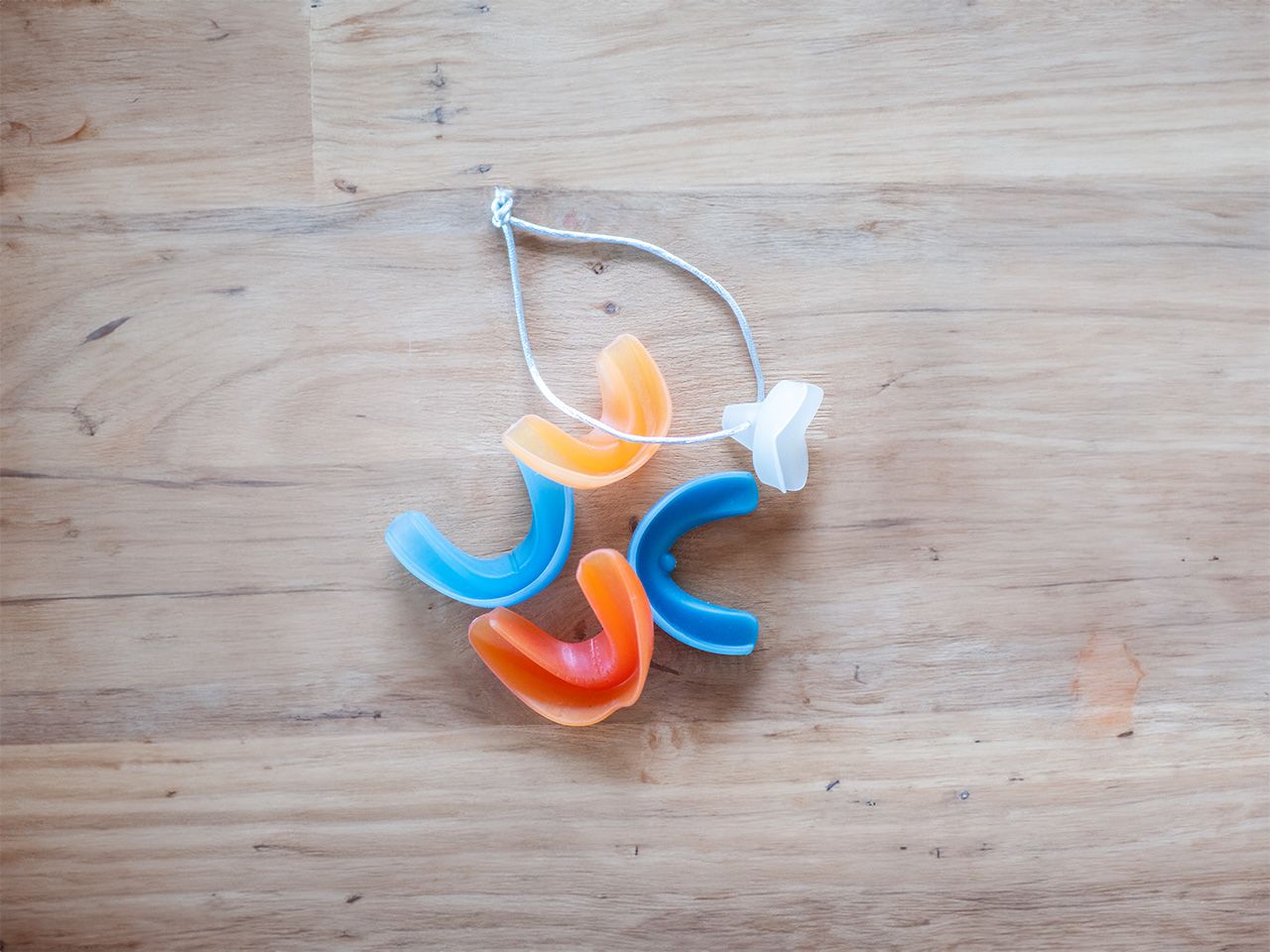
Functional: Special soft splints (not fixed braces) can train the muscles and may help guide the jaw into a more favorable functional position.
Sleep medicine evaluation: If sleep apnea is suspected, an examination in a sleep lab is important in order to rule out risks.
Conclusion: the tongue - an underestimated key
The position of your tongue is far more than a minor detail. It influences:
- Your breathing (day and night)Your sleep quality (and your partner's)Your jaw development (especially in children)Your posture (through muscular connections)Your general well-being (among other things, through sleep quality)
The good news: You can actively work on the factors you can influence. Through conscious training of tongue position, encouraging nasal breathing, and, where appropriate, professional support. In some people, optimizing tongue position, lip closure, and breathing can help reduce snoring.
Take a moment to notice where your tongue rests when at rest. Where is it right now, as you read this text? A little tip: it should rest against the palate, your mouth should be closed - and you should be breathing through your nose.
💡 Important note: This article is not a substitute for medical advice. If you have persistent symptoms or suspect sleep apnea, please consult a specialist. Snoring can be a symptom of serious conditions that require medical treatment. The exercises mentioned are not a substitute for the diagnosis or treatment of sleep apnea.
The content of this article is for general information and does not replace individual medical or dental advice. For questions about dentosophic approaches, a professional evaluation by an appropriately trained practitioner may be advisable.