

Dentosophy connects the teeth, breathing, and body posture. Learn how jaw problems can trigger neck pain - placed in scientific context.
What to expect:
Sound Familiar?
You wake up in the morning with a headache. Your neck is tense, as if you had carried a heavy backpack all night. Your jaw clicks when you chew - or you notice that your teeth are worn down, even though you "aren't really doing anything wrong."
Many people don't realize that these complaints are often linked to dysfunctions in the mouth - and not just with the teeth themselves, but with the entire control of breathing, swallowing, chewing, and posture.
This is exactly where dentosophy comes in - as a function-oriented approach grounded in measurable physiological processes.
What Does "Dentosophy" Mean - and What's Really Behind It?
The term "dentosophy" combines the Latin dens (tooth) with the Greek sophia (wisdom). It sounds mysterious - but it isn't.
In practice, dentosophy is about physiology: it's about how the jaw works, how it's connected to breathing, swallowing, posture, and the nervous system - and how disturbances in this system can lead to pain or misalignments.
Dentosophy is therefore not an alternative healing method, but a function-oriented approach within dentistry that draws on the following scientifically recognized principles:
- Neuromuscular control - how muscles and nerves work together
- Biomechanics of the jaw joints - how forces act within the mouth
- Postural control - how the jaw influences body posture
- Development of the jawbones in childhood
Why the Jaw Is More Than "Just Bone"
Think of your jaw not as a rigid bone, but as an active joint that is constantly communicating with the rest of the body.
Through the trigeminal nerve system - the strongest cranial nerve - the jaw continuously sends signals to the brain. These signals help the brain decide: Where is my head in space? Am I upright? Do I need to tense muscles to keep my balance?
When the jaw position is disturbed - for example by a misalignment, by teeth grinding (bruxism), or by mouth breathing - it can affect the entire postural system.
A retruded lower jaw position, for instance, can cause the neck muscles to be constantly tensed in order to stabilize the head. This may be associated with tension, headaches, and over the long term even changes in the spine.
The Role of Breathing: Nasal Breathing Versus Mouth Breathing
A central focus of dentosophy is restoring physiological nasal breathing. Why?
Because nasal breathing is not only richer in oxygen, but also shapes the entire facial skeleton - especially in childhood.
Children who breathe through their mouth permanently (e.g., due to enlarged adenoids or allergies) often develop a narrow, high palate, crowded teeth, a recessed lower jaw, and a forward-tilted head posture.
These changes are not a "matter of fate," but the result of a functional disturbance - and under certain conditions they can develop favorably if you intervene early enough.
Scientific background: Studies show that chronic mouth breathing in childhood correlates with an increased rate of orthodontic misalignments. Mouth breathers significantly more often show a retruded lower jaw, a steeper mandibular angle, and a higher palate than nasal breathers [(Harari et al., 2010)](onlinelibrary.wiley.com/doi/...); [(Chung Leng Munoz & Beltri Orta, 2014)](sciencedirect.com/science/ar...).
How Do Tooth and Jaw Misalignments Really Develop?
Many people believe crooked teeth are genetically determined. In reality, environmental factors and functional habits play at least an equally large role:
- •Use of bottles or pacifiers beyond the age of 2
- •Mouth breathing
- •Lack of chewing solid food (a soft diet)
- •Faulty swallowing patterns (the tongue pushing against the front teeth)
- •Chronic stress leading to teeth grinding and muscle overtension
These factors disrupt the natural development of the jawbones. Because bones don't simply grow "somehow" - they respond to mechanical stimuli.
The jawbones are constantly undergoing remodeling. When too little or the wrong forces act on the bone during chewing or swallowing, the body breaks down bone where it appears "unnecessary" - and a lack of space arises for the teeth.
The Connection Between the Jaw and Body Posture
This is where it gets especially interesting: the jaw is not isolated. It is connected to the entire body through muscular chains.
The chewing muscles connect with the neck muscles. The tongue muscles are attached to the hyoid bone, which in turn is connected to the front neck muscles and even to the rib cage. Through the vestibular system (the balance organ in the ear) and the eye muscles, the jaw position influences spatial orientation.
In medicine, these connections are called myofascial chains - and they explain why a problem in the mouth can contribute to or influence pain in the back, a tilted pelvis, or even foot problems.
Research note: A systematic review by [(Kerbrat et al., 2021)](ijoms.com/article/S0901-5027...) analyzed 13 clinical studies and found significant correlations between jaw misalignments and body posture, including links between lower jaw position and pelvic alignment as well as between jaw asymmetry and scoliosis.
What Makes Dentosophy Different From "Normal" Braces?
Dentosophy aims to address functional causes - that is, to treat the functional disturbances themselves.
Typical elements of dentosophic therapy:
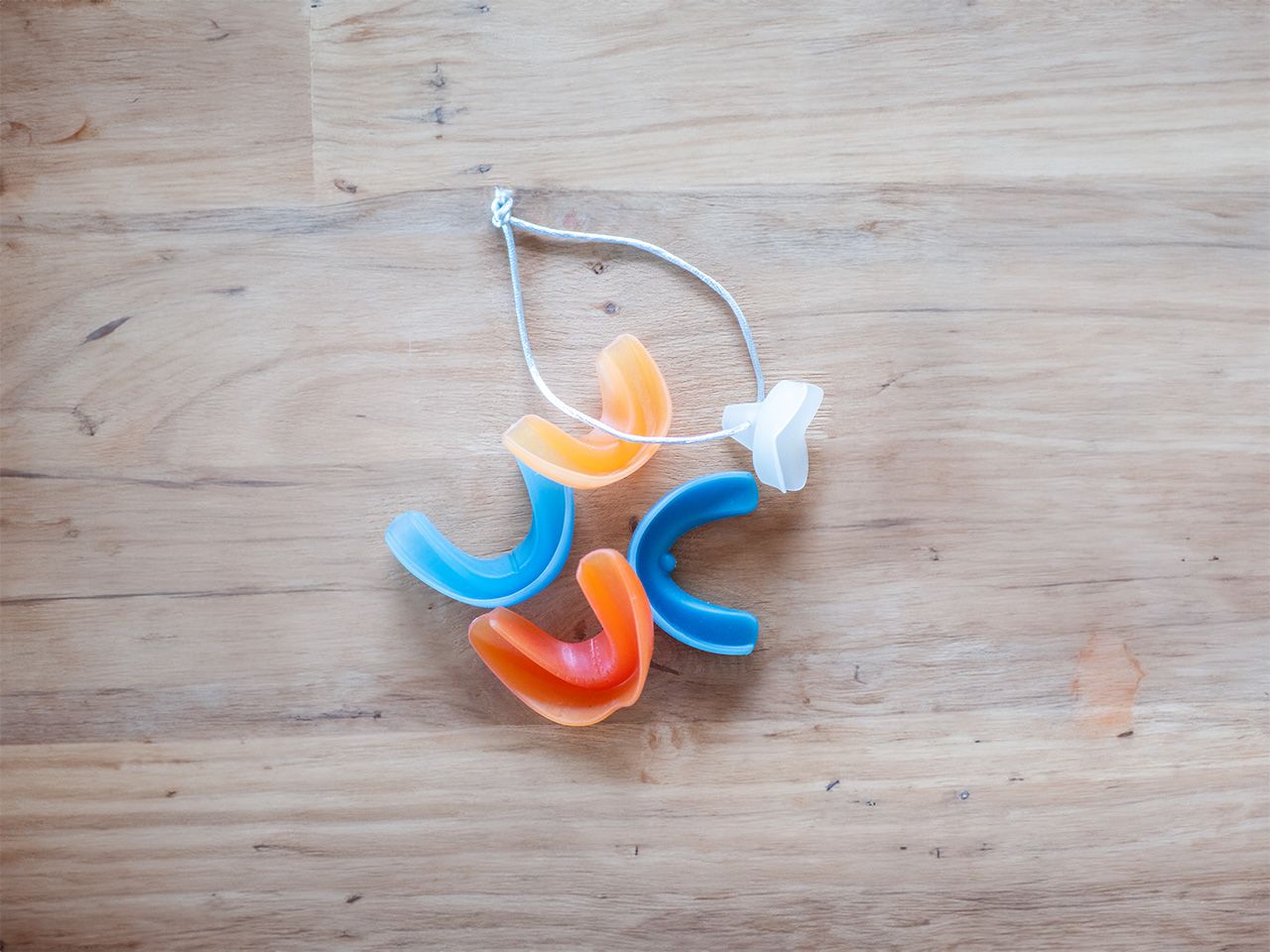
- Soft functional splints made of medical silicone or rubber - these splints are not rigid, but gently train the musculature.
- Specific exercises for correct tongue posture (at the palate, not between the teeth), physiological swallowing (without tensing the lips or cheeks), and nasal breathing training.
- Biomechanical tests - the patient is examined while standing and in motion to detect postural asymmetries.
- Nighttime splint use - to relieve the jaw joint and to influence the neuromuscular memory over the long term.
This therapy is based on the principle of neuromuscular reorganization - the brain learns new, healthy movement patterns that consolidate over time.
Who Is Dentosophy Suitable For?
Dentosophy can provide supportive benefits for various functional complaints as part of a holistic approach. Talk to a specialist about your individual situation.
- Chronic teeth grinding or clenching (bruxism)
- Jaw joint pain (TMJ - temporomandibular dysfunction)
- Mouth breathing (in adults too!)
- Snoring or sleep-related complaints (have these evaluated by a doctor)
- Tension in the neck, shoulders, or back without a clear orthopedic cause
- Tooth misalignments in children, especially when functional causes are present
In children, the therapy is often advantageous because the bones are still growing and can be reshaped more easily. But adults too can - with patience - use dentosophic approaches as a complementary functional concept.
What Does the Science Say?
The evidence varies depending on the component; individual functional connections are well studied, while the overall method is not established as a guideline term in every country:
- The influence of nasal breathing on jaw development is well established [(Harari et al., 2010)](onlinelibrary.wiley.com/doi/...)
- The connection between jaw position and posture has been demonstrated in several studies [(Gangloff et al., 2000)](sciencedirect.com/science/ar...); [(Kerbrat et al., 2021)](ijoms.com/article/S0901-5027...)
- The biomechanical connection between the skull, cervical spine, and hyoid bone is documented [(Rocabado, 1983)](tandfonline.com/doi/abs/10.1...)
However
The term "dentosophy" itself is not a standard medical term and does not appear in major clinical guidelines (e.g., those of national dental associations). But this does not mean the method is ineffective - it only means it is not an independent medical specialty, but a therapeutic orientation within functional dentistry.
Conclusion: It's About Functional Balance
Dentosophy is a practice-oriented approach that draws on the following insight: the mouth is not an isolated space - it is part of a complex control system that connects breathing, posture, swallowing, and stress responses.
If you suffer from unclear pain in the jaw, neck, or head - especially as a complementary evaluation for persistent complaints - it's worth having the function of your mouth examined closely.
Because sometimes a possible approach lies not in the neck - but between your teeth.
References
- Harari D et al. (2010): The effect of mouth breathing versus nasal breathing on dentofacial and craniofacial development in orthodontic patients. Laryngoscope, 120(10), 2089-2093. [DOI: 10.1002/lary.20991](onlinelibrary.wiley.com/doi/...) | [PubMed](pubmed.ncbi.nlm.nih.gov/2082...)
- Chung Leng Munoz I, Beltri Orta P (2014): Comparison of cephalometric patterns in mouth breathing and nose breathing children. Int J Pediatr Otorhinolaryngol, 78(7), 1167-1172. [DOI: 10.1016/j.ijporl.2014.04.046](sciencedirect.com/science/ar...) | [PubMed](pubmed.ncbi.nlm.nih.gov/2483...)
- Gangloff P et al. (2000): Dental occlusion modifies gaze and posture stabilization in human subjects. Neurosci Lett, 293(3), 203-206. [DOI: 10.1016/s0304-3940(00)01528-7](sciencedirect.com/science/ar...) | [PubMed](pubmed.ncbi.nlm.nih.gov/1103...)
- Kerbrat A et al. (2021): Interaction between posture and maxillomandibular deformity: a systematic review. Int J Oral Maxillofac Surg, 51(1), 104-112. [DOI: 10.1016/j.ijom.2021.05.003](ijoms.com/article/S0901-5027...) | [PubMed](pubmed.ncbi.nlm.nih.gov/3412...)
- Rocabado M (1983): Biomechanical relationship of the cranial, cervical, and hyoid regions. J Craniomandib Pract, 1(3), 61-66. [DOI: 10.1080/07345410.1983.11677834](tandfonline.com/doi/abs/10.1...) | [PubMed](https://pubmed.ncbi.nlm.nih.gov/6586872/)
- Proffit WR, Fields HW, Sarver DM (2019): Contemporary Orthodontics (6th edition). Elsevier.
The content of this article is for general information and does not replace individual medical or dental advice. For questions about dentosophic approaches, a professional evaluation by an appropriately trained practitioner may be advisable.